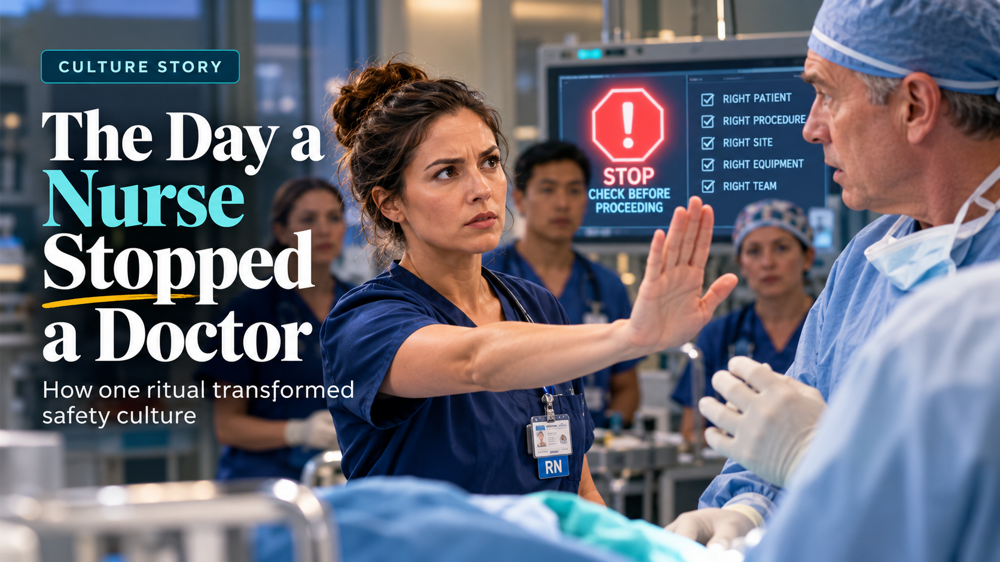
What happens when you give every employee permission to challenge authority? At Virginia Mason, one simple practice helped turn an old hierarchy into a culture where speaking up became everyone's responsibility.
By Roshan Thiran | Rituals of Work
The moment that changed everything
Imagine you are a nurse in a busy hospital.
A senior doctor is about to perform a procedure. You notice something isn't right. A safety protocol hasn't been followed.
What do you do?
You could remain silent. After all, the doctor is the expert. You're just the nurse. Perhaps you don't want to embarrass anyone. Perhaps you don't want to risk your career.
Or you could speak up.
In 2005, at Virginia Mason Medical Center in Seattle, a nurse faced precisely this situation.
She asked the physician to stop the procedure.
He refused.
What happened next is extraordinary.
Rather than backing down, the nurse activated something called a Patient Safety Alert (PSA). A hospital leader intervened, thanked the nurse and instructed the doctor to stop.
But the story didn't end there.
The physician berated the nurse for challenging him.
So she filed another safety alert, this time about the retaliation she had experienced.
Again, leadership intervened. The physician was taken off duty while the matter was addressed, and the hospital subsequently provided training on its patient safety culture.
Think about that for a moment.
A nurse challenged a doctor. The doctor challenged the nurse. And the organisation stood behind the nurse.
Not because she was more senior. Not because she was more powerful.
But because she had done what the organisation had repeatedly told everyone to do: put patient safety above hierarchy.
This was more than an incident. It was a moment when an organisation's stated values were tested in public, and leadership backed those values with action.
The problem: When silence becomes the culture
For years, healthcare had struggled with a dangerous contradiction.
Hospitals were full of highly trained people who genuinely wanted to care for patients. Yet hierarchical structures sometimes made it difficult for junior employees to question senior professionals.
Everyone cared about safety.
But caring wasn't enough.
The real question was whether someone would risk challenging authority when something went wrong.
That's the fascinating thing about organisational culture. We can put beautiful words on walls, print values in employee handbooks and run wonderful workshops on psychological safety.
But when a junior employee spots a mistake made by the CEO, the most senior engineer or a powerful doctor, what happens next?
Culture is revealed in that moment, not in the PowerPoint presentation.
In 2002, Virginia Mason's leadership, under CEO Dr Gary Kaplan, decided to confront this problem differently.
They went looking for answers in an unlikely place.
Not another hospital.
A Toyota factory in Japan.
The ritual: Stop the line
At Toyota, workers could flag a defect and stop a production line before a problem travelled further down the manufacturing process.
The principle was beautifully simple.
Don't allow a small problem to become a bigger one merely because nobody has the courage or authority to stop the process.
Virginia Mason brought this thinking into healthcare through its Patient Safety Alert system.
The practice was straightforward:
- See something unsafe. Any employee, regardless of job title, identifies a mistake, near miss or situation that could harm a patient.
- Speak up immediately. The employee raises an alert and can stop the potentially harmful activity.
- Leaders respond. A designated leader assesses the concern, protects the patient and coordinates the necessary response.
- Fix the underlying problem. Teams investigate what went wrong and improve the system, rather than simply looking for someone to blame.
- Reinforce the behaviour. Leaders follow up, recognise employees who speak up and regularly remind everyone that protecting patients is their responsibility.
This wasn't a once-a-year training programme.
It was a recurring organisational practice embedded into the everyday rhythm of work.
An employee could raise an alert by phone or online. Leaders followed up. Safety was discussed in daily leadership rounds. Employees who identified important problems were recognised through programmes such as the monthly Good Catch award.
Over time, speaking up became something employees were expected to do, not something reserved for the exceptionally brave.
And here's the insight I find most fascinating.
The ritual did not eliminate fear overnight. It created repeated opportunities for leaders to demonstrate that speaking up was safe.
Every alert became a small test of the culture.
Every respectful response helped build trust.
And every problem that was actually fixed gave employees another reason to believe that their voices mattered.
When the numbers began to tell a different story
Here's where the story becomes particularly interesting.
When Virginia Mason introduced the system in 2002, employees submitted an average of approximately three patient safety alerts per month.
By 2006, that figure had climbed to 285 per month.
By the end of 2014, the average had reached 879 per month.
In September 2020, the organisation reached its 120,000th cumulative patient safety alert.
Now, some people might look at those numbers and panic.
"What? More problems being reported? Surely our culture is getting worse!"
But that's the wrong interpretation.
The increase showed that employees were increasingly willing to make problems visible.
And invisible problems are incredibly difficult to solve.
The organisation reported other encouraging outcomes:
- Staff participation in the Culture of Patient Safety survey rose from 16% in 2004 to 88% in 2013.
- In 2013, 80% of respondents agreed that staff could speak up freely about potential threats to patient safety.
- Professional liability claims fell by 74% between May 2005 and May 2015.
These results should not be attributed to one ritual alone. Virginia Mason also invested heavily in broader process improvement, leadership development and safer systems.
But the Patient Safety Alert practice was an important mechanism through which the organisation turned its commitment to safety into observable behaviour.
And that's what matters.
The hospital didn't simply encourage people to care. It gave them a repeatable way to act on that care.
The deeper lesson: Rituals redistribute power
I've spent much of my career helping organisations transform their cultures, and one thing continues to surprise me.
Leaders often believe culture changes when people begin thinking differently.
I believe the more powerful route is often the reverse.
Get people to behave differently, repeatedly, in an environment where the right behaviour is supported, and gradually the organisation begins to think differently too.
Virginia Mason illustrates this beautifully.
Before the Patient Safety Alert system, challenging authority could feel personally dangerous.
After the new practice was embedded, speaking up had a recognised channel, a clear process and visible leadership support.
The organisation wasn't merely asking employees to be courageous.
It was changing the conditions under which courage could be exercised.
But there was another critical ingredient.
Leaders had to accept being challenged.
Remember the nurse who stopped the doctor?
Imagine what might have happened if the hospital had punished her or quietly ignored her complaint.
One incident could have undermined years of training about speaking up.
Instead, leadership reinforced the behaviour it wanted.
This is why I often argue that culture is not defined by what leaders announce. Culture is defined by what leaders repeatedly reinforce, reward and tolerate.
The ritual mattered.
But the leadership response gave the ritual credibility.
What can your organisation learn from this?
You don't need to run a hospital or build cars to apply this thinking.
Imagine introducing a simple five-minute ritual in your Monday team meeting.
Ask everyone one question:
"What is one problem, risk or uncomfortable truth that we are currently not talking about?"
Allow anyone to raise an issue.
Don't immediately defend, explain or dismiss it.
Assign someone to investigate or act on it.
And at the following meeting, begin by reviewing what happened to the concerns raised previously.
Think what could change.
A junior employee might flag a customer complaint that has been ignored for months.
A finance executive might reveal a process that makes honest reporting unnecessarily difficult.
An operations technician might highlight a recurring equipment problem before it causes a costly shutdown.
Or someone might finally challenge an inefficient process that everyone complains about privately but nobody has dared to question publicly.
Of course, the ritual will fail if leaders punish the messenger, dismiss uncomfortable observations or never close the loop.
But when employees repeatedly experience that speaking up leads to respectful action, something begins to change.
Silence becomes less attractive.
Ownership becomes more common.
Trust begins to grow.
And the organisation develops the capacity to notice and solve problems that previously remained hidden.
The real transformation
The greatest achievement at Virginia Mason wasn't simply the number of safety alerts submitted.
It was the shift in what ordinary employees felt able and responsible to do.
A nurse could challenge a doctor.
A nonclinical employee could report a hazard.
A physician could acknowledge a mistake.
And a leader could turn an uncomfortable interruption into an opportunity for learning.
That's a fundamentally different culture.
Not because someone wrote a better values statement.
But because people were given a practice they could repeat, leaders reinforced it, and the organisation learned to behave differently.
And perhaps that's the greatest lesson of all: Culture doesn't change when we tell people what's important. It changes when we make what's important something people actually do.
So here's my question for you:
What is the one behaviour your organisation desperately needs, but your current routines, systems and leadership responses are not making possible?
Don't start by writing another value on the wall.
Start by designing a ritual that makes that behaviour possible, visible and repeatable.
Because in the end, culture is what we repeat.
The ritual at a glance
Organisation: Virginia Mason Medical Center, Seattle, USA
Culture challenge: Hierarchy and fear of speaking up about potential safety failures
Ritual: Patient Safety Alert, inspired by Toyota's stop-the-line practice
Trigger: An employee notices a potential safety issue, mistake or near miss
Action: Raise an alert, intervene to prevent harm and activate a leadership response
Reinforcement: Daily leadership engagement, follow-up, process improvement and recognition of employees who speak up
Desired behaviour: Employees at every level identify risks, challenge unsafe practices and take responsibility for preventing harm
Documented outcomes: More than 120,000 cumulative alerts by September 2020; 80% positive responses on speaking up freely in the 2013 survey; 74% fewer professional liability claims from May 2005 to May 2015
The culture principle: Psychological safety is strengthened when speaking up is routinely supported by leadership action, not merely encouraged through words.
*
This article was brought to you by Budaya*
Sources and research credibility
- Virginia Mason Institute: Embedding a System to Protect Patient Safety. The detailed account of the nurse and physician, leadership responses, survey results and professional liability outcomes.
- Furman & Caplan (2007), Joint Commission Journal on Quality and Patient Safety. The peer-reviewed study documenting 6,112 alerts by December 2006 and their resolution practices.
- Virginia Mason: Production System Success Stories. The organisation's own account of the 120,000-alert milestone